Loading...


Your passion for psychology deserves everything you need to excel.
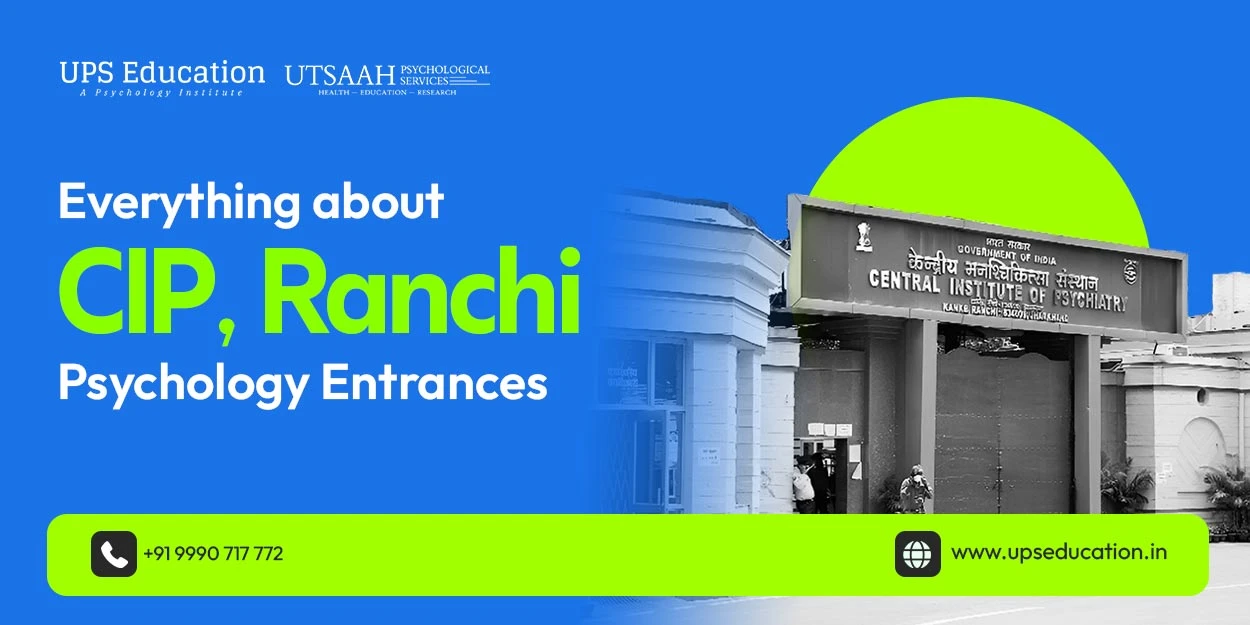
The Central Institute of Psychiatry (CIP) is one of India’s most influential institutions for mental health, neuroscience, and behavioural studies. Established in 1918, it’s one of the oldest and most pioneering mental health institutions. Known for its long legacy of firsts, from introducing ECT, psychosurgery, and India’s earliest clinical psychology services to founding the Indian Psychiatric Society, CIP has shaped the country’s modern psychiatric practice. Today, it stands as an open-campus hospital with state-of-the-art neuroimaging and psychosocial departments, offering high-quality clinical care, training, and research under the Ministry of Health & Family Welfare.
CIP Ranchi does not offer any bachelor’s or master’s level programmes like BA/BSc or MA/MSc Psychology. Instead, it focuses more on advanced, professional-level training. Currently, it offers postgraduate psychology programmes such as:
The MA Clinical Psychology (RCI) (formerly MPhil Clinical Psychology) at CIP Ranchi offers supervised training that includes a balanced mix of theory, clinical practice, and research. The program is offered in regular mode, recognised by the Rehabilitation Council of India (RCI) for obtaining a license as a clinical psychologist.
The duration of the MA Clinical Psychology (RCI) (formerly MPhil Clinical Psychology) course at CIP Ranchi is 2 years and offers a total of 22 seats (subject to change every year). Here’s a further classification of seats by categories:
NOTE: The number of seats is subject to change every year. Seats will be reserved in accordance with the Central Government’s Reservation Policy.
Admission to CIP Ranchi’s MA Clinical Psychology (RCI) (formerly MPhil Clinical Psychology) program, for all categories, will be based on an Entrance Examination comprising a Computer-Based Test (CBT) and a Practical/Interview.
Candidates will have to answer 100 Multiple-Choice Questions within 60 Minutes in the CBT test.
To apply for the MA Clinical Psychology (RCI) program at CIP Ranchi, candidates must meet the following criteria:
Eligible candidates can apply online through the official CIP Admission portal. Applicants are advised to:
Applications must be submitted online only. Incomplete or offline applications will not be accepted.
The Computer-Based test (CBT) for MA Clinical Psychology (RCI) (formerly MPhil Clinical Psychology) entrance will be held across the major cities throughout the country. The cities include Mumbai, New Delhi, Kolkata, Chennai, Ahmedabad, Hyderabad, Bangalore, and Ranchi. While the candidates are usually allotted their preferred choices for centers, the final exam center will be allotted based on logistical feasibility among the three chosen centers.
There is no fixed time for the CIP, Ranchi’s MA Clinical Psychology (RCI) entrance for every year, but tentative dates are:
CIP Ranchi do not charge any fee for its MA Clinical Psychology (RCI)(Formerly MPhil Clinical Psychology) program, as it is funded by the Government of India. Students do, however, need to pay minimal administrative charges, like application/examination fees and security deposit (refundable).
Q1. The tendency to give greater weight to some causes rather than to others is known as:
A. self-fulfilling prophecy
B. person perception
C. stereotyping
D. attribution biases
Correct Option: D. Attribution biases
Q2. Cross-cultural experiences suggest that pictorial cues for depth perception are
A. innate
B. learned
C. universal
D. irrelevant
Correct Option: B. Learned
Q3. People who have a strong desire to succeed in attaining goals may be high in the need for:
A. Achievement
B. Attention
C. Power
D. Affiliation
Correct Option: A. Achievement
Q4. The formula for changing a raw score to a Z score is:
A. z = (X-M)/SD
B. Z = (X+M)/SD
C. z = (X-SD)/M
D. Z = (M-SD)/X
Correct Option: A. z = (X − M) / SD
Q5. According to Kohlberg's theory of moral development, in which stage morality is judged in terms of what satisfies own needs or those of others?
A. Stage 1
B. stage 2
C. stage 3
D. Stage 4
Correct Option: B. Stage 2 (Instrumental–Relativist Orientation)
Q6. ______________ intelligence refers to accumulated knowledge-information we store over a lifetime of experience, plus the application of skills and knowledge to solving specific problems.
A. Fluid
B. Crystallized
C. Practical
D. Contextual
Correct Option: B. Crystallized
Q7. In DSM-5, Body Dysmorphic Disorder is placed in:
A. Mood Disorder
B. Somato-form disorder
C. Anxiety disorder
D. OCD and related disorders
Correct Option: D. OCD and related disorders
Q8. The tendency to falsely believe, through revision of older memories to include newer information, that one could have correctly predicted the outcome of an event is known as:
A. Misinformation effect
B. Constructive processing
C. Hindsight bias
D. Recency effect
Correct Option: C. Hindsight bias
Q9. The need for social approval is an example of a ____________ drive.
A. primary
B. instinctive
C. innate
D. acquired
Correct Option: D. Acquired
Q10. Our ability to recognize the emotions of others, to understand these feelings, and to experience
them ourselves at least to a degree is called:
A. Temperament
B. Sympathy
C. Empathy
D. Attachment
Correct Option: C. Empathy
Q11. Which cranial nerve is responsible for relaying information about choking to the nucleus of the solitary tract?
A. Olfactory nerve
B. Optic nerve
C. Glossopharyngeal nerve
D. Abducens nerve
Correct Option: C. Glossopharyngeal nerve (CN IX carries choking/gag reflex info)
Q12. Which hormone is primarily responsible for mobilizing energy reserves during the alarm reaction stage of the General Adaptation Syndrome (GAS)?
A. Cortisol
B. Adrenaline (epinephrine)
C. Insulin
D. Growth hormone
Correct Option: B. Adrenaline (epinephrine) (primary for alarm stage; cortisol dominates resistance)
Q13. What is the role of the vagus nerve in the stress response?
A. It controls the release of adrenaline and non-adrenaline
B. It coordinates the body's response to stress
C. It relays information about stress from body to the brain
D. It controls cortisol directly in stressful situations
Correct Option: C. It relays information about stress from body to brain
Q14. Which gland produces lymphocytes?
A. Thyroid gland
B. Adrenal gland
C. Thymus gland
D. Pituitary gland
Correct Option: C. Thymus gland
Q15. Which hormone is primarily responsible for the fight-or-flight response in the SAM model?
A. Cortisol
B. Adrenaline (epinephrine)
C. Corticotropin-releasing-hormone (CRH)
D. Vasopressin
Correct Option: B. Adrenaline (epinephrine)
Students preparing for the MA Clinical Psychology (RCI) entrance exam at CIP Ranchi may find the following books helpful in their preparation. These texts cover core areas such as psychopathology, assessment, research methodology, statistics, and clinical theories.
PhD in Clinical Psychology at CIP Ranchi is a two-to-four-year full-time doctoral program that combines advanced clinical training with intensive research.
Admission to CIP Ranchi’s PhD in Clinical Program, for all categories, will be based on an Entrance Examination comprising a Computer-Based Test (CBT) and a Practical/Interview.
Candidates will have to answer 100 Multiple-Choice Questions within 60 Minutes in the CBT test.
To get admission into CIP, Ranchi’s PhD Clinical Psychology program, the applicants must meet the following criteria:
Eligible candidates can apply online through the Official CIP Admission Portal.
Applicants are advised to:
Applications must be submitted online only. Incomplete or offline applications will not be accepted.
The Computer-Based test (CBT) for PhD Clinical Psychology entrance will be held across the major cities throughout the country. The cities include Mumbai, New Delhi, Kolkata, Chennai, Ahmedabad, Hyderabad, Bangalore, and Ranchi. While the candidates are usually allotted their preferred choices for centers, the final exam center will be allotted based on logistical feasibility among the three chosen centers.
Contact us at UPS Education or reach out using the contact details provided below:
Contact no: +91-9990717772
Website: upseducation. in
Comprehensive study material and e-portal. The portal provides a thorough practice of giving multiple exams and also lets you know where you stand in terms of rankings. Special guidance before interviews is very helpful. Truly grateful to UPS education. (Madhureema Neglur, CIP Ranchi)
I’ve been following UPS Education and Arvind Sir on Instagram for almost two years, and joining them truly helped me crack NFSU Gandhinagar, CIP Ranchi, and IHBAS. The study materials, videos, mock tests, and constant updates along with the ever-responsive UPS query team made my preparation structured and confident. The doubt-clearing sessions and timely emails about admissions were incredibly helpful. I’m genuinely thankful to UPS Education and Arvind Sir for guiding me throughout my MPhil journey. (Mrunalini Murlai, CIP Ranchi)
I recently cracked the M.Phil Entrance Exam at CIP, Ranchi by enrolling myself at UPS Education. I’m a part of the UGC-NET and M.Phil. offline batch, and my experience has been great. The classes are detailed, and the material and mock tests are helpful for regular self-evaluation. (Anshika Dhar, CIP Ranchi)
It was worth joining UPS education for MPhil entrence Even after completing a master's, there is so much to learn, especially when it's about the entrance exam. UPS education provided with notes, strategies, lectures, and self-assessment for a good preparation. It was all worth. (Akanksha Rohilla, CIP Ranchi)
- (Swati Agarwal, CIP Ranchi)
The best we could find in India I must say, they consistently guided, supported and motivated me till I crack NET-JRF and MPhil Clinical Psychology Entrance in CIP Ranchi. (Gayathri Narayan, CIP Ranchi)
A good place to learn for those looking for guidance while preparing for various psychology entrances. The e-learning portal, mock tests, and topic-wise questions give you a clear sense of your strengths and weaknesses, making preparation more focused. The motivation and consistency provided by faculty like Arvind Sir make a huge difference in my preparation. (Pankaj Narayan, CIP Ranchi)
- I had done my Masters in Psychology from IGNOU and had no teacher to guide me in the field of psychology. I discovered UPS Education videos on YouTube last year which helped me get my concepts clear. I used to give their weekly psychology quizzes and gradually got the courage to apply for M.Phil. I had joined their distance learning course for M.Phil. entrances and found their test series to be quite helpful for exam preparation.
I always wanted to be a Clinical Psychologist and was overjoyed to get selected at Central Institute of Psychiatry, Ranchi for M.Phil. Clinical Psychology. UPS Education has been there to help me throughout my preparation and I am grateful for their guidance and support. (Shreya Prabhu, CIP Ranchi)
I was able to strengthen my foundational understanding of concepts thanks to the UPS Institute. They gave me access to a highly customised website that encouraged me to push myself. They made learning fun while getting ready for the lengthy procedure. (Anet Augustine, CIP Ranchi)
They have a plethora of mocks for us to practise from and Arvind Sir really goes the extra mile for helping us prepare for our interviews. Big shout out to the UPS team. Thanks a ton! Definitely contributed a lot in my Mphil journey! (Aditya Chakraborty, CIP Ranchi)
UPS Education is the only one-stop solution for M.Phil Clinical Psychology aspirants. Arvind Otta Sir’s constant support, encouragement, and faith in me make me work even harder and better each time. He has been a pillar of strength throughout my journey. The online portal equips me with the knowledge, practice, and feedback that form the core of my preparation. I am truly grateful to UPS Education and Arvind Otta Sir for their invaluable guidance. (Huda Khan, CIP Ranchi)
I had an amazing experience taking coaching at UPS Education. Arvind Sir explained all the concepts clearly and provided dedicated doubt-clearing sessions after each class, which greatly enhanced my understanding. The notes provided by the institute were exceptionally well-tailored with the competitive exam perspective in mind. The online portal, with its mock test options, gave me a strong foundation for practicing MCQ-based formats. This helped me become familiar with the exam pattern and significantly improved the way I approached questions during the actual test. I'm sincerely grateful to Arvind Sir for all the guidance he provided. I also want to extend a huge thank-you to the support team, who always responded promptly whenever I had questions, whether about the classes, the portal, or any other concerns. Once again, a heartfelt thank-you to the entire team and Sir. I would definitely recommend UPS Education to anyone seeking reliable, result-oriented guidance on their journey to becoming a Clinical Psychologist. (Yangchen Doma, CIP Ranchi)

.webp) Arvind Otta
-8%
Arvind Otta
-8%
 250+ H Lessons
 230 Student
Arvind Otta
-9%
230 Student
Arvind Otta
-9%
 240+ H Lessons
253 Student
240+ H Lessons
253 Student
 Arvind Kumar
-7%
Arvind Kumar
-7%
 236+ H Lessons
380 Student
Arvind Otta
-13%
226+ H Lessons
450 Student
236+ H Lessons
380 Student
Arvind Otta
-13%
226+ H Lessons
450 Student
.webp) Arvind Otta
-8%
Arvind Otta
-8%
 200+ H Lessons
345 Student
200+ H Lessons
345 Student
.webp) Arvind Otta
-9%
Arvind Otta
-9%
 Arvind Otta
-8%
Arvind Otta
-8%

Leave Your Query
Your details will not be published.