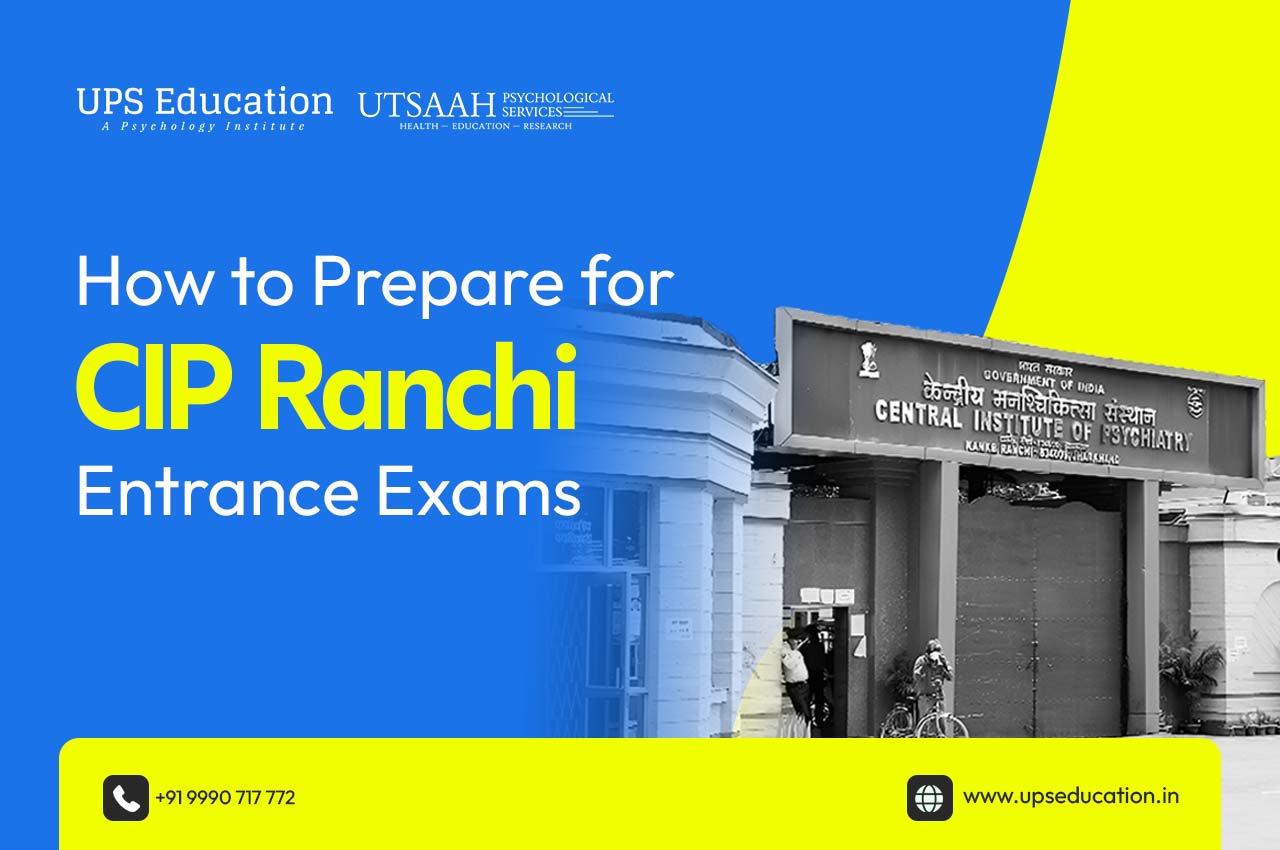
Central Institute of Psychiatry (CIP), Ranchi, is one of the oldest and most influential institutions for mental health & psychology in India. Established in 1918, it has a long history of firsts in psychology and mental health and has shaped the modern psychiatric practice in the country. Now, it operates under the Ministry of Health & Family Welfare and is recognized by the Rehabilitation Council of India (RCI), meeting the regulatory requirements for professional training in clinical psychology, offering clinical care, training, and research.
Before being known as MA Clinical Psychology (RCI), the program at CIP was known as MPhil Clinical Psychology, and even before that, it was known as the Diploma in Medical and Social Psychology (DMSP). With the standardization of training, the diploma was upgraded to MPhil Clinical Psychology and became a standard for licensing clinical psychologists. With the recent changes and introduction of NEP 2020, the program at CIP Ranchi was once again upgraded. It has now transitioned into MA Clinical Psychology (RCI-regulated), which represents the current postgraduate program to get clinical psychologist training and an RCI license.
Syllabus for MA Clinical Psychology (RCI) (formerly MPhil Clinical Psychology)
CIP doesn’t officially share the syllabus of the MA Clinical Psychology (RCI) (formerly MPhil Clinical Psychology), but its entrance exam is based on the MA/MSc in Psychology. Mentioned below are some of the recurring topics that came up in the previous year’s entrances:
Course Duration and Number of Seats for MA Clinical Psychology (RCI) at CIP
The MA Clinical Psychology (RCI) is a 2-year RCI-recognized program.
The total number of seats available for the program at CIP is 21 + 1 (for PwD) (subject to change annually).
Entrance Exam Pattern for MA Clinical Psychology (RCI) at CIP
The CIP Ranchi’s entrance exam includes a Computer-Based Test (CBT) and an Interview/Practical. The final selection of candidates will be based on the combined marks obtained in the CBT & Interview/Practical.
The CBT will consist of 100 multiple-choice questions.
The total time allotted is 60 Minutes.
Each correct answer will give +1 mark.
Wrong answers will not give negative marks, and Unanswered questions will give 0 marks.
The Interview/Practical will be of 50 Marks.
Preparation Tips & Study Strategy for CIP Ranchi Entrance Exam
Preparing for an entrance exam, like CIP Ranchi, requires not just subject knowledge but a balanced approach that focuses on clarity, consistency, and mental well-being. Below are some practical tips that you can use to prepare effectively.
1. Build Healthy Study Habits
Create a dedicated, distraction-free study space.
Minimize unnecessary screen time.
Keep a positive mindset and stay flexible, learn from mistakes, and adjust your strategy when needed.
Stay hydrated and take short breaks during long study sessions. Include light stretching, meditation, or walks to manage stress.
2. Understand and Organize the Syllabus
Get a clear idea of the topics with the help of syllabus (attached above), as CIP’s entrance will be based on it.
List all core psychology topics & keep your undergraduate and postgraduate notes easily accessible for revision.
3. Read Smart, Not Excessively
Study relevant topics from standard textbooks and credible sources.
Avoid overwhelming yourself by reading the same topic from too many books.
Focus on conceptual understanding rather than rote memorization.
4. Make Effective Notes
Write consolidated notes in your own words.
Highlight key terms, theories, and researchers.
Use active study techniques such as:
Pomodoro method
Mnemonics
Mind maps and flowcharts
5. Use Additional Learning Resources
Attend lectures or watch conceptual videos for topics you find difficult.
Audio-visual learning often helps clarify complex concepts better than self-reading.
Connect with fellow aspirants and join a study group to discuss doubts and revise together.
6. Revise, Practice, and Analyze
Revise your notes regularly, not just at the end.
Practice MCQs topic-wise and mock tests.
Identify weak areas and give them extra attention.
Never hesitate to seek guidance or mentorship during your preparation.
Ask doubts from your mentors regularly, and make sure to clear them with their help.
How UPS Education’s Coaching Programs Can Help Prepare
Preparing for an exam like CIP Ranchi requires more than just subject knowledge; you need strategic preparation, conceptual clarity, and consistent practice.
Not only do we provide classes, but we also provide candidates with specifically customized notes for the entrance exam they are preparing for.
Additionally, candidates can practice and simulate the entrance exam environment using the timed mock tests available on our e-learning portal and identify areas for improvement.
With constant guidance and immediate resolution of doubts, we help you prepare strategically, making sure your concepts are clear with consistent practice.
Reviews of UPS Education’s Successful Students Who Cleared the CIP Entrance
I recently cracked the M.Phil Entrance Exam at CIP, Ranchi by enrolling myself at UPS Education. I’m a part of the UGC-NET and M.Phil. offline batch, and my experience has been great. The classes are detailed, and the material and mock tests are helpful for regular self-evaluation. – Anshika Dhar
I had an amazing experience taking coaching at UPS Education. Arvind Sir explained all the concepts clearly and provided dedicated doubt-clearing sessions after each class, which greatly enhanced my understanding. The notes provided by the institute were exceptionally well-tailored with the competitive exam perspective in mind. The online portal, with its mock test options, gave me a strong foundation for practicing MCQ-based formats. This helped me become familiar with the exam pattern and significantly improved the way I approached questions during the actual test. I’m sincerely grateful to Arvind Sir for all the guidance he provided. I also want to extend a huge thank-you to the support team, who always responded promptly whenever I had questions, whether about the classes, the portal, or any other concerns. Once again, a heartfelt thank-you to the entire team and Sir. I would definitely recommend UPS Education to anyone seeking reliable, result-oriented guidance on their journey to becoming a Clinical Psychologist.– Yangchen Doma
I had done my Masters in Psychology from IGNOU and had no teacher to guide me in the field of psychology. I discovered UPS Education videos on YouTube last year which helped me get my concepts clear. I used to give their weekly psychology quizzes and gradually got the courage to apply for M.Phil. I had joined their distance learning course for M.Phil. entrances and found their test series to be quite helpful for exam preparation. I always wanted to be a Clinical Psychologist and was overjoyed to get selected at Central Institute of Psychiatry, Ranchi for M.Phil. Clinical Psychology. UPS Education has been there to help me throughout my preparation and I am grateful for their guidance and support. – Shreya Prabhu
Recommended Books to Prepare for MA Clinical Psychology (RCI)
Students preparing for the MA Clinical Psychology (RCI) entrance exam at CIP Ranchi may find the following books very helpful in their preparation. These texts cover core areas such as psychopathology, assessment, research methodology, statistics, and clinical theories.
Sample Questions for MA Clinical Psychology (RCI) at CIP
Q1. The function of mass communication of supplying information regarding the process issues, events, and societal development is known as: A. Content Supply B. Surveillance C. Gratification D. Correlation Correct Option: B. Surveillance
Q2. A physical stimulus is converted into a neural impulse by a process known as: A. Transposition B. Transaction C. Transduction D. Transition Correct Option: C. Transduction
Q3. Which of the following types of acceptance is most critical and pervasive to the long-range emotional health of a child? A. Peer B. Sibling C. Self D. Vocational Correct Option: C. Self
Q4. What hormones, secreted by the pineal gland, increase when periods of darkness begin and promote feelings of drowsiness? A. Testosterone B. Melatonin C. Cortisol D. Epinephrine Correct Option: B. Melatonin
Q5. Which of the following illnesses caused by long-term abuse of alcohol often involves profound retrograde amnesia? A. Alzheimer’s Disease B. Parkinson’s Disease C. Huntington’s Disease D. Korsakoff’s Disease Correct Option: D. Korsakoff’s Disease
Q6. Which of the following has been associated with conduct disorder in adolescence? A. Criminal Behaviors leading to a prison sentence. B. Psychosis C. Antisocial Personality Disorder D. All of the above Correct Option: C. Antisocial Personality Disorder
Q7. Which of the following is not information provided in DSM-IV-TR? A. Essential Features of the disorder B. Associated Feature C. A list of symptoms that must be present for diagnosis D. Information on treatment options Correct Option: D. Information on treatment options
Q8. The relative apparent motion of objects in the visual field as the viewer moves the head is called: A. Retinal Image Shift B. Accommodation C. Motion Parallax D. None of the above Correct Option: C. Motion Parallax
Q9. If two presynaptic neurons coincidentally stimulate a postsynaptic neuron, their combined effects on that neuron are described by a process called: A. Soma Summation B. Temporal Summation C. Cholinergic Summation D. Spatial Summation Correct Option: D. Spatial Summation
Q10. Which cranial nerve is responsible for relaying information about choking to the nucleus of the solitary tract? A. Olfactory nerve B. Optic nerve C. Glossopharyngeal nerve D. Abducens nerve Correct Option: C. Glossopharyngeal nerve (CN IX carries choking/gag reflex info)
Q11. Which hormone is primarily responsible for mobilizing energy reserves during the alarm reaction stage of the General Adaptation Syndrome (GAS)? A. Cortisol B. Adrenaline (epinephrine) C. Insulin D. Growth hormone Correct Option: B. Adrenaline (epinephrine) (primary for alarm stage; cortisol dominates resistance)
Q12. What is the role of the vagus nerve in the stress response? A. controls the release of adrenaline and non-adrenaline B. coordinates the body’s response to stress C. relays information about stress from body to the brain D. controls cortisol directly in stressful situations Correct Option: C. relays information about stress from body to brain
Q13. Which gland produces lymphocytes? A. Thyroid gland B. Adrenal gland C. Thymus gland D. Pituitary gland Correct Option: C. Thymus gland
Q14. Which hormone is primarily responsible for the fight-or-flight response in the SAM model? A. Cortisol B. Adrenaline (epinephrine) C. Corticotropin-releasing-hormone (CRH) D. Vasopressin Correct Option: B. Adrenaline (epinephrine)
Need More Help?
Feel free to contact us at UPS Education or reach out using the contact details provided below: